








Google started its November 2026 core update on 10 Nov 2026. On 16 Nov 2026 it was still rolling out. Google says it may take up to two weeks, and it is global, in all languages. Black Friday is on 27 Nov, so the update and the sale season may overlap.
Here is the short answer for Indian bloggers, small business owners and affiliate site owners. Do not panic. Rule out technical problems today. Save your numbers for 3 to 9 Nov. Then wait until Google says the update is done, plus one full week, before you change anything big.
Short on time? Tap through the short Web Story version of this guide.
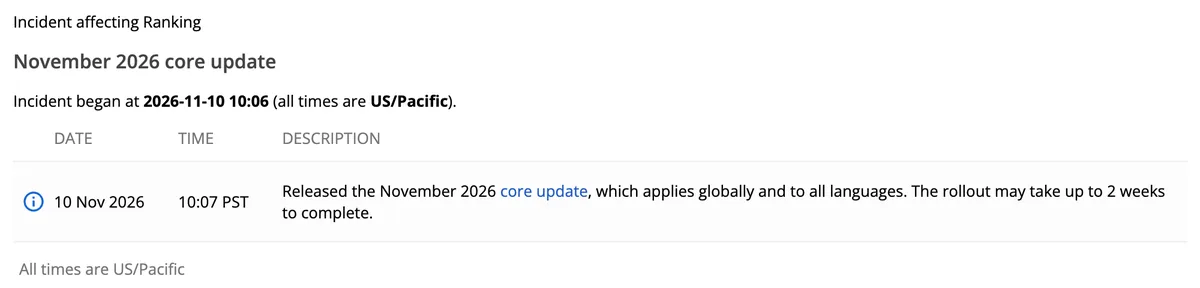
Still rolling out. Google's status dashboard shows the November 2026 core update as open, with no end date. It began on 10 Nov 2026 at 10:06 am US Pacific time, which is 11:36 pm IST. Google's estimate is up to 2 weeks.
On this page14 sections
What is a Google core update?
A Google core update is a broad change to how Google ranks pages in Search. It does not target one site. It changes how Google judges all pages for a search, so some pages move up and others move down.
Google explains it with a list of favourite restaurants. If you rewrite your top 20 list today, new places may join it. A place that drops is not bad. Other places just did better. That is how Google describes a core update in its core updates guide.
Google makes these updates several times a year. It also makes smaller core updates it does not announce, because they are hard to notice.
What Google has said about this update
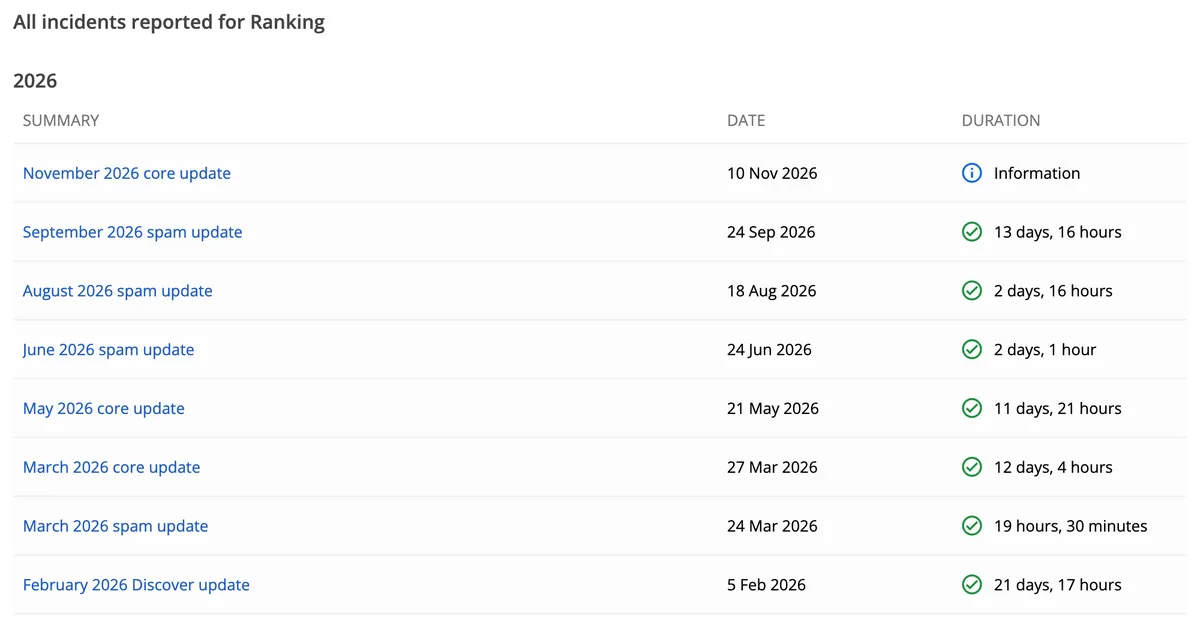
Google said three things on its Search Status Dashboard. The update was released on 10 Nov 2026. It applies globally and to all languages. The rollout may take up to 2 weeks to complete. Here is the entry as we saw it, logged out, on 16 Nov 2026.
Google’s Search Central team also posted on LinkedIn. Search Engine Journal and Search Engine Roundtable quoted that post. It called this a regular update meant to better surface relevant, satisfying content for searchers from all types of sites.
That is all. Search Engine Land reported that Google shared no new guidance for this update. Google did not name any site type, topic or tactic that it targets.
In India, 10:06 am US Pacific time on 10 Nov is 11:36 pm IST on the same day. So if you track daily data in Indian time, the first full day of the update is 11 Nov.
The 2026 timeline, from Google’s own list
Google lists every confirmed ranking update on its ranking history page. This is the 2026 list, with the length Google shows for each one. November is the third core update of the year.
| Update | Started | Length on Google’s dashboard |
|---|---|---|
| February 2026 Discover update | 5 Feb 2026 | 21 days, 17 hours |
| March 2026 spam update | 24 Mar 2026 | 19 hours, 30 minutes |
| March 2026 core update | 27 Mar 2026 | 12 days, 4 hours (done 8 Apr) |
| May 2026 core update | 21 May 2026 | 11 days, 21 hours (done 2 Jun) |
| June 2026 spam update | 24 Jun 2026 | 2 days, 1 hour |
| August 2026 spam update | 18 Aug 2026 | 2 days, 16 hours |
| September 2026 spam update | 24 Sep 2026 | 13 days, 16 hours |
| November 2026 core update | 10 Nov 2026 | Still rolling out on 16 Nov 2026 |
Dates and lengths from Google's Search Status Dashboard, read 16 Nov 2026.
How long past core updates really took
Google says up to two weeks. Past updates often took longer. We counted the last ten core updates on Google’s own list. Six of the ten ran longer than 14 days. Both November updates before this one ran for more than three weeks.
| Core update | Started | Length |
|---|---|---|
| November 2023 | 2 Nov 2023 | 25 days, 21 hours |
| March 2024 | 5 Mar 2024 | 45 days |
| August 2024 | 15 Aug 2024 | 19 days, 4 hours |
| November 2024 | 11 Nov 2024 | 23 days, 13 hours |
| December 2024 | 12 Dec 2024 | 6 days, 4 hours |
| March 2025 | 13 Mar 2025 | 13 days, 21 hours |
| June 2025 | 30 Jun 2025 | 16 days, 18 hours |
| December 2025 | 11 Dec 2025 | 18 days, 2 hours |
| March 2026 | 27 Mar 2026 | 12 days, 4 hours |
| May 2026 | 21 May 2026 | 11 days, 21 hours |
Dates and lengths from Google's Search Status Dashboard, read 16 Nov 2026.
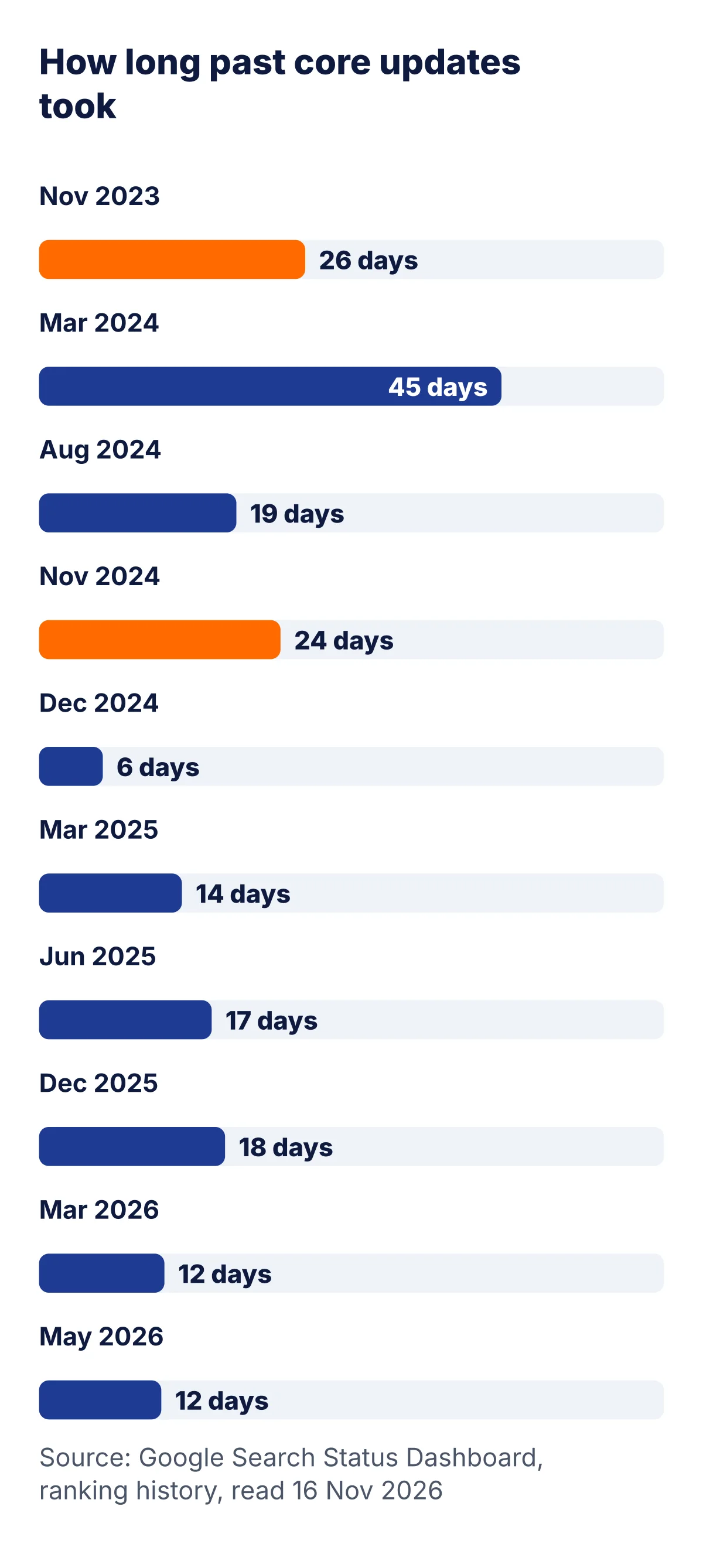
What this means for you: if this update keeps to two weeks, it ends near 24 Nov. If it runs like November 2024, it could still be moving rankings on Black Friday and Cyber Monday. Nobody outside Google knows which one it will be.
What Google says vs what trackers and news report
Lots of claims fly around during a rollout. Some come from Google. Many come from rank tools, agencies and forum posts. This table keeps them apart. You can see what is fact and what is a report.
| Claim | Who said it | How solid it is |
|---|---|---|
| Released 10 Nov, global, all languages, up to 2 weeks | Google Search Status Dashboard | Official |
| A regular update to surface relevant, satisfying content from all types of sites | Google’s LinkedIn post, as quoted by Search Engine Journal and Search Engine Roundtable | Official words, read through news quotes |
| No new guidance for this update | Search Engine Land, 10 Nov | News report |
| Big ranking movement on 8 and 9 Nov, before the announcement | Search Engine Roundtable, 9 Nov, with charts from tools such as Semrush, Sistrix and others | Tracker data. Google has not said this was part of the update |
| Rank trackers picked up sizable movement earlier in the week | Coalition Technologies, 10 Nov | Agency report |
| About 173 days since the May update started | Coalition Technologies | Matches Google’s dates (21 May to 10 Nov) |
| Gemini 4 Carbon reached AI Mode on the same day | Google blog, 10 Nov. Coalition notes there is no confirmed link to the update | Official launch. No link to the update is confirmed |
Dates and lengths from Google's Search Status Dashboard, read 16 Nov 2026.
Rank trackers watch their own list of keywords and score how much the results move. Each tool has its own list and its own maths. A high score says results are moving. It does not say why, or if your site moved.
Who lost so far? What we know and what we do not
Google does not publish winners and losers. On 16 Nov 2026 we looked for a winners and losers study of this update. We wanted one from a named data company that we could check. We did not find one yet. Such studies usually come after a rollout ends. For example, Amsive published one for the March 2026 update using SISTRIX data.
You will see forum posts about sites that lost most of their traffic overnight. Those are real stories from real people, but each one is one site. They cannot tell you what the update rewards.
What we can do is read Google’s own self-assessment questions. They show which pages are most at risk in any core update. These are Google’s questions in our plain words:
- Copied or rewritten pages. Google asks if your page avoids simply copying or rewriting other sources, and adds real value of its own.
- Pages with nothing new. Google asks if a page gives original information, research or analysis, beyond the obvious.
- Pages with no clear author. Google asks if it is clear who wrote the page. It calls fake author profiles, such as AI headshots or made-up names, a form of deception.
- Pages made only for search. Google asks why the content exists. If the main reason is to get search visits, it says that is not what its systems reward.
- Mass pages made with automation to rank. Google’s spam policy calls that scaled content abuse.
For affiliate sites, this often means thin “best X” lists. They repeat the brand’s own text. They have no tests, no photos and no real opinion. That is our reading of Google’s questions, not a list Google published for this update.
A calm, step-by-step plan
This plan follows Google’s core updates guide. It works for a blog, a shop or an affiliate site. Steps 1 to 3 are for today. Steps 4 to 7 come after the rollout ends.
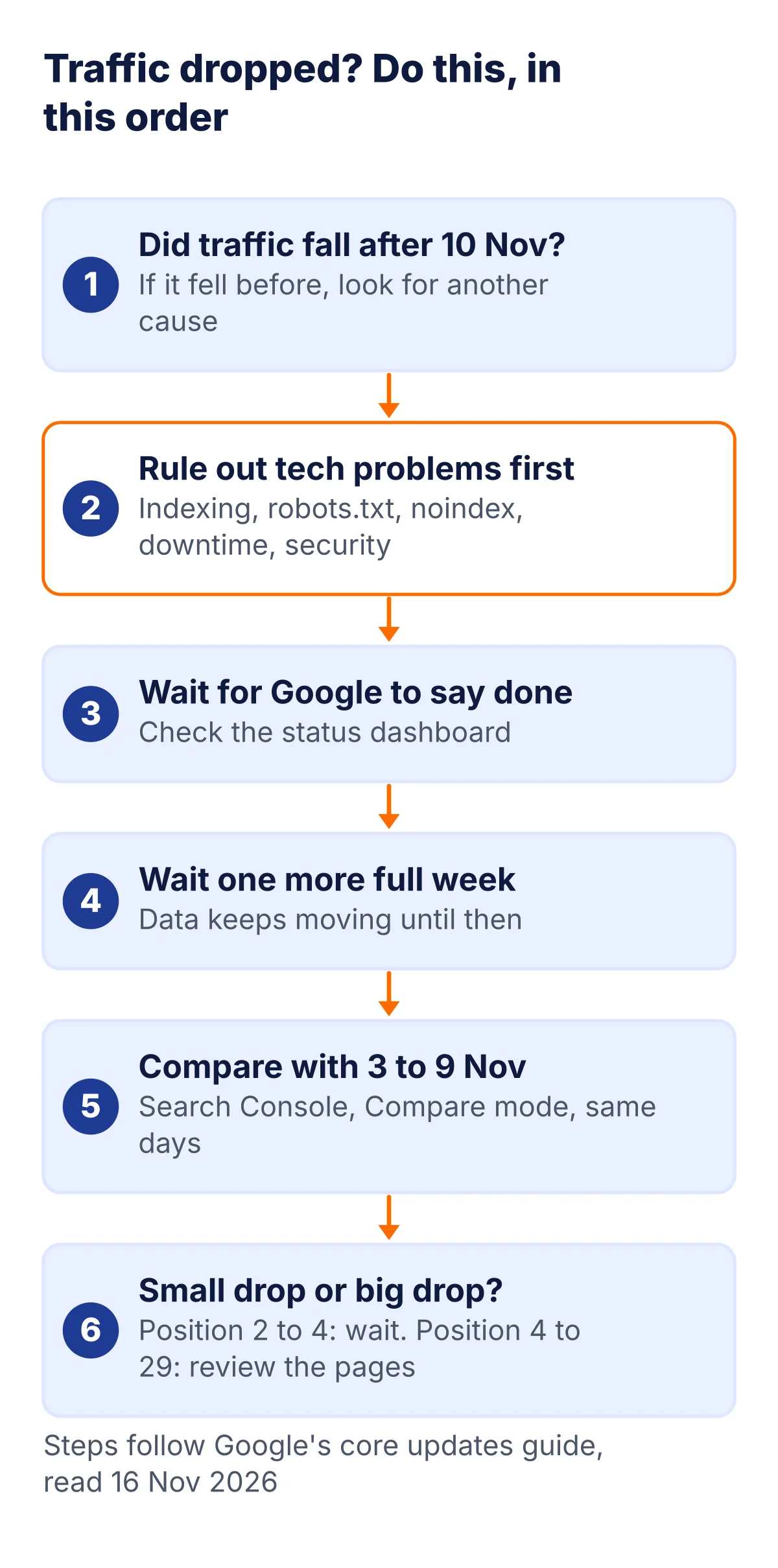
Step 1: Write down the start date
Note 10 Nov 2026 in the place you keep site notes: a sheet, your analytics notes, or a text file. Later, when you see a dip on a chart, you will know the update was running.
Step 2: Save your baseline week, 3 to 9 Nov
This is the last full week before the update. Search Engine Journal and SiteGround both point to the week before 10 Nov as the baseline. In Google Search Console:
- Open Performance, then Search results.
- Click the date filter, choose Custom, and set 3 Nov 2026 to 9 Nov 2026.
- Open the Pages tab and click Export. Do the same for the Queries tab.
- Save the files with the dates in the name, for example baseline-3-9-nov-2026.
We are not showing a Search Console screenshot here on purpose. It holds private site data. Your own report will have the same menus.
Step 3: Rule out technical problems today
A technical problem can look just like a core update drop. Unlike the update, you can fix it now. Check these five things:
- Indexing. Paste a page that dropped into URL Inspection at the top of Search Console. Is it indexed? Then open Indexing, Pages and see if “Not indexed” jumped.
- Noindex by mistake. In WordPress, open Settings, Reading, and make sure “Discourage search engines from indexing this site” is not ticked.
- robots.txt. Open yoursite.com/robots.txt. A line that says
Disallow: /underUser-agent: *blocks the whole site. - Downtime. Check your uptime monitor or your host’s status page. In Search Console, Settings, Crawl stats shows when Google had trouble reaching your server.
- Penalties and hacks. Open Security and Manual actions. Look at both Manual actions and Security issues.
If you find a problem, fix it now. If everything is fine, the change is most likely the update, and the best move is to wait.
Step 4: Wait for Google to say it is done
Check the status dashboard. When the update ends, Google adds a final line, like it did for May: “The rollout was complete as of June 2, 2026.” Note that end date.
Step 5: Wait one more full week
Google says to wait at least a full week after a core update ends. Only then look at your site in Search Console. Rankings keep moving during the rollout. Data from the middle of it is a moving target.
Step 6: Compare the right two weeks
- In Performance, Search results, click the date filter and open the Compare tab.
- Pick Custom. Put the new full week first and 3 to 9 Nov second. Use the same weekdays in both.
- Look at the Pages and Queries tabs. Sort by the difference in clicks and in average position.
- Check Web, Image, Video and News search types one by one. Google suggests this in its guide.
- If most of your visitors are in the US or UK, use the Countries tab. Holiday shopping changes how people search there in late November.
The holiday season makes this harder. A US deal page may get more clicks in Black Friday week even if it ranks lower. So look at average position, not only clicks. SiteGround also suggests comparing with the same week last year.
Step 7: Judge small drops and big drops differently
Google gives two examples. A small drop, like position 2 to 4, needs no drastic action. Google even says to avoid changing content that already performs well. A large drop, like position 4 to 29, needs a deeper look.
For a large drop that lasts, read Google’s self-assessment questions for your whole site, not just one page. Ask someone you trust who has no link to your site to rate your pages. Search your main query and read the pages now above you. Ask: what do they give a reader that we do not?
A simple sheet to track it
Copy this into a spreadsheet. One row per important page. It keeps you honest and stops panic edits.
Page URL | Main query | Position 3-9 Nov | Clicks 3-9 Nov | Position after | Clicks after | Small or big drop | Tech check OK? | Notes
/best-hosting-india/ | best hosting india | 4.2 | 120 | ... | ... | ... | yes | example row only
The numbers in the example row are made up to show the format. Use your own.
Do not make panic edits during the rollout
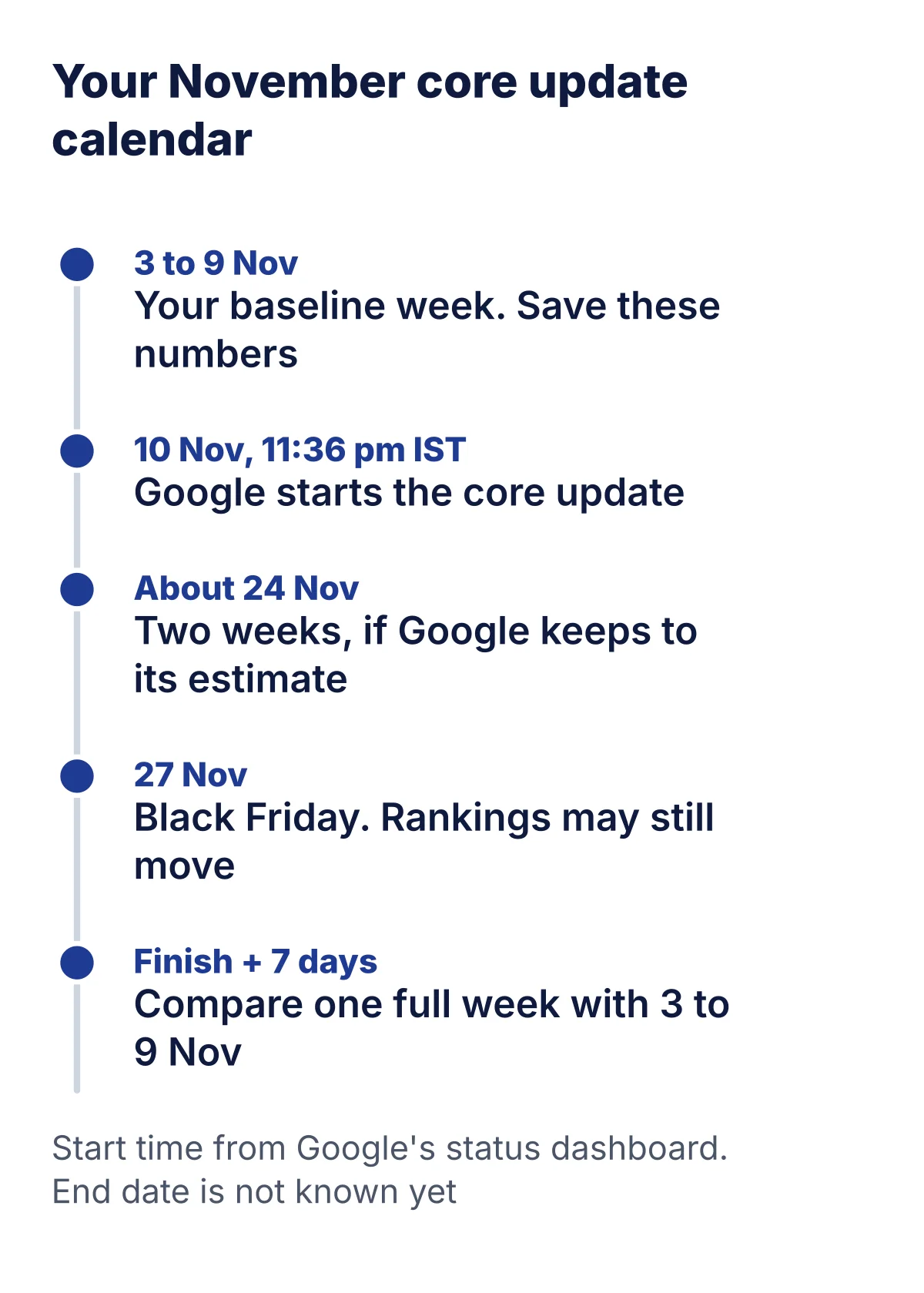
Rankings can go down and back up while an update rolls out. If you change many pages now, you will not know later what caused what. Google warns against quick-fix changes, such as removing a page element because someone said it is bad for SEO.
| Safe to do now | Wait until after the rollout plus one week |
|---|---|
| Fix a broken page, a noindex mistake or downtime | Rewriting whole articles because a ranking slipped |
| Correct a wrong price, an expired coupon or a wrong date | Deleting pages or whole sections |
| Apply security updates | Changing URLs, adding redirects or merging pages |
| Publish new pages you had already planned | Changing titles and headings on many pages at once |
| Answer real reader questions in a page | Buying links or mass-making new pages with AI |
Dates and lengths from Google's Search Status Dashboard, read 16 Nov 2026.
Google calls deleting content a last resort. If you want to delete whole sections, Google says they may have been made for search engines first. Decide that calmly, with data, after the rollout.
How this update meets AI Overviews and AI Mode
Two AI changes came to Google Search in the same week. They are not part of the core update. But they can change your clicks at the same time. Here are the checked facts:
- 10 Nov: Google said Gemini 4 Carbon is rolling out to Google AI Ultra subscribers, including in AI Mode in Search (Google blog).
- 12 Nov: Google said Gemini 4 Hydrogen is now in Google Search globally for all users. It says Hydrogen improves query fan-out and links to a broader range of sites (Google blog, by Robby Stein). Search Engine Roundtable reports it is now the default model in AI Mode and is used for harder questions in AI Overviews.
- 9 to 11 Nov: Google confirmed a logging error that lowered impressions in Search Console’s Generative AI performance report for those days. It affects data logging only (Google’s data notes, reported by Search Engine Roundtable on 12 Nov).
Google’s AI features guide says the same SEO basics apply to AI Overviews and AI Mode. To be shown as a supporting link there, a page must be indexed and eligible to show in Search with a snippet. Clicks and impressions from these AI features are counted in the Search Console Performance report, under the Web search type.
So what should you do? Leave out 9 to 11 Nov when you compare AI impressions. If your average position stayed the same but clicks fell, the page layout may have changed rather than your ranking. Look at the search result yourself before you blame the update. For more on getting quoted by AI tools, read our guide to SEO for AI search.
Black Friday advice for affiliate sites
Many Indian affiliate sites earn most of their year in late November, often from US and UK buyers. This update lands right before that. Here is what we suggest, based on Google’s guides and plain good sense.
- Keep facts fresh. Check every price, coupon and end date on your deal pages. Wrong facts hurt readers, update or no update. Change the date on a page only when you really changed its content.
- Do not rebuild your money pages now. Keep the same URLs, titles and layout until the rollout ends plus one week.
- Add real proof where you have it. Your own screenshots of a checkout or a dashboard you used, with a date, help readers. Google asks if a page shows first-hand expertise.
- Keep your disclosure clear. Put your affiliate disclosure above the first affiliate link, in plain words.
- Do not mass-produce deal pages. Hundreds of thin AI pages made to catch searches fit Google’s description of scaled content abuse.
- Do not rely on Google alone this week. Send deals to your email list, WhatsApp channel or YouTube audience. A ranking drop then hurts less.
- Check your site can take the traffic. Test your pages on a phone, check your cache, and take a backup before changes.
If you run Black Friday deal pages, our own Black Friday deals hub shows how we keep each deal dated and checked.
What we checked, and what we did not
On 16 Nov 2026 we opened Google’s Search Status Dashboard while logged out. We took the two screenshots on this page and read the rollout lengths from Google’s ranking history. We counted the last ten core updates ourselves to get the six of ten figure.
We read Google’s core updates guide, its helpful content guide, its AI features guide and two Google blog posts. We read five news and agency pages for what others reported, and we name each one next to its claim.
We have not measured how this update affected any site, including ours. We do not share private Search Console data. Any traffic number you see in news or forum posts is that publisher's own claim.
How we chose
Frequently asked questions
Is the Google November 2026 core update finished?
Not yet. On 16 Nov 2026 Google’s Search Status Dashboard still showed it as open, with no end date. It started on 10 Nov 2026 and Google said it may take up to 2 weeks. Check the dashboard for the latest status.
When did the November 2026 core update start in India?
It started at 10:06 am US Pacific time on 10 Nov 2026. That is 11:36 pm IST on 10 Nov 2026.
What is a Google core update?
A core update is a big, broad change to how Google ranks pages. It does not target one site or one page. Google does it several times a year and lists each one on its status dashboard.
Will it finish before Black Friday?
Maybe. Two weeks from 10 Nov is about 24 Nov, three days before Black Friday on 27 Nov. But 6 of the last 10 core updates took longer than 14 days. So plan as if rankings may still move on Black Friday.
My traffic dropped. Is it the core update?
Maybe, but check technical problems first: indexing, robots.txt, a noindex tag, downtime and security warnings. If all of those are fine, wait until Google says the update is done, then wait one more week before you judge.
Which baseline week should I use?
Use 3 to 9 Nov 2026. It is the last full week before the update started on 10 Nov. Compare it with one full week that starts at least seven days after Google marks the update complete.
Who lost in the November 2026 core update?
Google does not name winners or losers. On 16 Nov 2026 we found no checkable winners and losers study for this update from a named data company. Early posts on forums are single-site stories, not proof.
Should I update my pages during the rollout?
Fix real problems and real facts, such as a broken page, a wrong price or an expired coupon. Do not rewrite, delete, redirect or rename pages just because rankings moved. Google warns against quick-fix changes.
Does this update target AI-written content?
Google has not named any target for this update. Its guide says to make helpful, reliable content for people. Its spam policy says using automation mainly to manipulate rankings is a violation, whoever or whatever wrote it.
Does the core update change Google Ads?
Core updates change organic search rankings. Google Ads are paid placements sold through a separate auction, so a core update is not a change to your ads.
How long does recovery take after a core update?
Google says some changes show in a few days. But it can take months for Google to trust that a site got better. Sometimes you must wait for the next core update.
About this page

- WordPress developer and designer, builds sites for clients
- WordCamp Asia Communication Co-Lead
- 14K+ subscribers on the DigitalPritam YouTube channel
How we checked
Updated 16 Nov 2026How I got these facts
I read each Google page on 16 Nov 2026 and took the screenshots the same day, logged out. The rollout lengths are copied from Google’s ranking history. For the India time, I added 13 hours 30 minutes to the US start time. India is 5 hours 30 minutes ahead of world time (UTC). US Pacific time was 8 hours behind it that day.
Sources
- Google Search Status Dashboard: November 2026 core update incident, read 16 Nov 2026
- Google Search Status Dashboard: History for Ranking, and incidents.json, read 16 Nov 2026
- Google Search Central: Google Search’s core updates and your website (last updated 10 Dec 2025), read 16 Nov 2026
- Google Search Central: Creating helpful, reliable, people-first content (last updated 5 Oct 2026), read 16 Nov 2026
- Google Search Central: AI features and your website (last updated 10 Dec 2025), read 16 Nov 2026
- Google blog: Gemini 4 Carbon is now available, 10 Nov 2026
- Google blog: Google Search gets a major upgrade with Gemini 4 Hydrogen, Robby Stein, 12 Nov 2026
- Search Engine Roundtable: Google November 2026 Core Update Is Rolling Out (10 Nov), Google Search Ranking Volatility November 9th (9 Nov), Search Console Generative AI report data bug (12 Nov), Gemini 4 Hydrogen (12 Nov)
- Search Engine Journal: Google’s November 2026 Core Update Starts Rolling Out, Matt G. Southern, 10 Nov 2026
- Search Engine Land: Google November 2026 core update rolling out now, Barry Schwartz, 10 Nov 2026
- SiteGround blog: Google November 2026 core update: What to check before Black Friday, Erin Ridley, 13 Nov 2026
- Coalition Technologies: November 2026 Google Core Update, Jordan Brannon, 10 Nov 2026
- Amsive: Google March 2026 Core Update winners and losers analysis (method note only)
What to do next
Today, run the five technical checks and export your 3 to 9 Nov numbers. Then close Search Console and work on your Black Friday pages. Come back one full week after Google marks the update done, and compare calmly.
Keep reading
 SEO for AI search
 19 SEO tips
 What is SEO?
 Black Friday deals
 FREE PDF
Get the Hostinger setup checklist, plus every sale alert
The exact steps we use on our lab sites, and an email when each big hosting sale opens.
Sent instantly. Deal alerts until 1 Dec. Unsubscribe in one click.

 Pritam Sonone