







Disclosure: some links on this page are affiliate links. If you buy through them we may earn a commission, at no extra cost to you.
SEO means search engine optimization. It is the work of making your page easy for Google to find, read and trust. When it goes well, the right people see your page when they search.
Think of it like a shop on a busy street. A clear sign, a tidy window and a helpful owner bring people in. SEO does the same job for a website.
Google says there are no shortcuts to a top spot. A change can take a few hours to several months to show. We read Google's own guides on 15 Nov 2026 for the facts here.
Short answer. SEO is helping people find your page through search. Start with helpful content, clear titles and a site that loads well. Then wait and learn from Search Console.
On this page16 sections
What does SEO mean?
Google describes SEO in its own SEO Starter Guide. It says SEO helps search engines understand your content. It also helps people find your site and decide whether to visit it.
So SEO has two jobs. One job is for the search engine: show it what your page is about. The other job is for people: give them a page worth clicking.
The big word to remember is helpful. A page that answers a question well, in plain words, is the best base for SEO.
Why SEO matters
Most people use search when they need an answer. If your page shows up, you get a visit without paying for an ad. Here is what that gives you.
- Steady visits. A good page can keep bringing readers for months.
- Ready readers. People searching already want what you offer.
- Trust. Readers often trust pages that show up for a plain question.
- Lower cost over time. You pay in work, not in ad clicks.
- A base for everything else. Social posts fade. A page stays.
SEO is not magic. It is slow. But it adds up, because each good page works for you while you sleep.
Who needs SEO?
Almost any site that wants visitors from search can gain from SEO. These are the most common cases.
- Bloggers. Posts bring readers only if people can find them.
- Small businesses. Someone near you searches for what you sell.
- Online shops. Product pages need clear names and honest details.
- Freelancers and agencies. A helpful page can bring in new clients.
- Course and software makers. Buyers often search before they buy.
If nobody ever needs to find you on Google, you can skip SEO. For everyone else, it is worth learning the basics.
How SEO works in three stages
Google explains how Search works on its page How Google Search works. It has three stages. Not every page makes it through every stage.
The three stages of Google Search
- 1Crawling
Google finds pages and downloads their text, images and videos with a program called Googlebot.
- 2Indexing
Google works out what the page is about and stores it in a very large database called the index.
- 3Serving results
When someone searches, Google shows the pages it thinks are most helpful and relevant.
Stage 1: crawling
Google needs to know your page exists. It finds new pages by following links from pages it already knows. You can also send a list of your pages, called a sitemap.
Google does not crawl every page it finds. A page can be blocked by the owner. A page behind a login cannot be read. A slow or broken server can also get in the way.
Stage 2: indexing
After crawling, Google tries to understand the page. It reads the text, the title, the images and their alt text. It also checks if the page copies another page. It picks one version as the main one.
Google says indexing is not guaranteed. Low quality, a rule that blocks indexing, or a hard-to-read design can keep a page out.
Stage 3: serving results
Now someone searches. Google looks in its index and shows the pages it thinks are best. It uses many signals, such as the person’s place, language and device. Two people can see different results for the same words.
Google also says it does not accept payment to crawl a site more often or to rank it higher. Anyone who says otherwise is wrong.
The four parts of SEO
People split SEO into four parts. You do not have to master all four on day one.
| Part | What it means | A simple example | Where to learn more |
|---|---|---|---|
| Content | Pages that answer what people ask | A clear guide on one question | Keyword research |
| On-page | Titles, headings, text and images on the page | A title that says what the page is | 19 SEO tips |
| Technical | Speed, mobile view and access for Google | A fast page that works on a phone | WordPress SEO plugins |
| Off-page | Links and mentions from other sites | A site that links to your guide | 19 SEO tips |
Prices from Mangools and SE Ranking, read 15 Nov 2026.
If you only have time for one, start with content. A great page on a weak site still helps people. A weak page on a perfect site helps nobody.
SEO words in plain English
SEO has a lot of jargon. This table explains the words you will meet most.
| Word | What it means |
|---|---|
| Keyword | A word or phrase people type into a search box |
| Crawler (Googlebot) | The Google program that finds and reads pages |
| Index | Google’s large database of pages it has read |
| Sitemap | A list of your pages that you can send to Google |
| Snippet | The short text Google shows under a result |
| Anchor text | The clickable words in a link |
| Alt text | A short description of an image, for people who cannot see it |
| Backlink | A link to your page from another site |
| Canonical page | The main version Google picks when pages look alike |
Prices from Mangools and SE Ranking, read 15 Nov 2026.
What good on-page SEO looks like
Google’s guide lists simple habits. They are easy to say and take work to do well.
- Clear titles. Each page needs its own short title that says what it is about.
- Honest summaries. The page description should tell people what they will find.
- Headings that split the text. Use them to break a long page into parts.
- Useful links. Use words that describe the page you link to, not just the words click here.
- Images with context. Use clear pictures and descriptive alt text.
- Plain, original writing. Say something new, in words people use.
Do not stuff your page with the same word again and again. It makes the page hard to read. Write for the person first.
SEO and AI answers
Many people now get answers from AI tools, including Google’s AI Overviews and AI Mode. Does that change SEO?
Google says no special work is needed for these features. In its page on AI features and your website, Google says to use the same SEO best practices. There is no extra technical rule, except that your page must be indexed and able to show a snippet.
So the plan stays the same. Be helpful, be clear and be easy to crawl. Our list of AI SEO tools covers tools that also track AI answers. We have not tested them all.
How to get started with SEO
You can do your first round of SEO in one afternoon. Follow these steps in order.
Your first SEO afternoon
- 1Pick one topic
Choose a question your readers ask often.
- 2Find the words people use
Use free tools first. See our keyword research guide.
- 3Write one helpful page
Answer the question in plain words, near the top.
- 4Fix the basics
Add a clear title, a short summary, headings and alt text.
- 5Link it up
Link to your related pages and ask a friendly site to link to you.
- 6Check it on a phone
Make sure it loads fast and is easy to read.
- 7Watch and wait
Use Search Console, then give it a few weeks.
Step 2 is where many beginners stall. Our guide on how to do keyword research walks through it in five steps. Step 4 and 5 have more detail in our 19 SEO tips.
If your site runs on WordPress, a plugin can help with titles and summaries. See our guide to the best WordPress SEO plugin.
Free and paid SEO tools
You can start with free tools. As you publish more, a paid tool saves time. Here is how the main ones compare, from their own pages.
| Google Search Console | Mangools | SE Ranking | |
|---|---|---|---|
| Price | Free | Basic from $18.85 a month on the yearly plan | Core $103.20 a month on the yearly plan, $129 monthly |
| Best for | See how Google shows your site | Easy keyword research | Keyword research and rank tracking in one place |
| Try it first | Free to use | Free account, 5 lookups a day | 14-day free trial |
| Refund | Not needed | 48 hours, as stated on its page | Not read |
Prices from Mangools and SE Ranking, read 15 Nov 2026.
Prices are in US dollars before tax. They come from each vendor’s own pages, read on 15 Nov 2026. Our own page on Mangools pricing and SE Ranking pricing shows every plan.
 Pick Mangools ifOur pick
- You are new to SEO
- You want a simple tool for keyword research
- You want a free account to try first
- Plans limit daily lookups.
 Pick SE Ranking if
- You want research and tracking together
- You work on more than one site
- You want a free trial before you pay
- It costs more than Mangools.
If you want a deeper comparison, see SE Ranking vs Semrush. We have not tested every feature of either tool.
Common SEO mistakes
- Writing for Google, not people. A page that reads oddly will not keep readers.
- Copying other pages. Say something of your own.
- Giving up too soon. Google says to give a change a few weeks.
- Hiding the page. A rule that blocks Google can keep a page out of search.
- Paying for a promise. Google says no one can pay it to rank a site higher.
- Skipping the phone. Many readers use one.
SEO myths that waste time
Here are three myths you will hear. They are easy to drop once you know the facts.
Myth 1: you can buy a top spot. Google says it does not accept payment to rank a site higher. Ads are separate, and they are marked as ads.
Myth 2: SEO is one task. It is a habit. Pages, links and the web all keep changing.
Myth 3: one trick works for every site. Google says there is no guaranteed shortcut. Every site needs useful pages and a good experience.
How we chose
Frequently asked questions
What does SEO stand for?
SEO stands for search engine optimization. It means making your pages easy for search engines to find, read and show to the right people.
Is SEO free?
The basics are free. Writing helpful pages, clear titles and good links costs time, not money. Google also says it does not accept payment to crawl a site more often or rank it higher. Paid tools help you work faster, but you do not need them to start.
How long does SEO take to work?
Google says a change can take anywhere from a few hours to several months to show up. It suggests waiting a few weeks before you judge if it worked. Plan for patience.
Can anyone guarantee a number one rank?
No. Google says there are no secrets or shortcuts that guarantee a top spot. If someone promises it, walk away.
Do I still need SEO now that people use AI answers?
Yes. Google says you do not need special tricks for AI Overviews and AI Mode. The same good SEO practices apply, and your page must be indexed and eligible to show a snippet.
What is the difference between SEO and paid ads?
Ads are paid and stop when you stop paying. SEO earns free visits over time from pages that keep working. Many sites use both.
Do I need a tool to do SEO?
No. Google Search Console is free and shows how your site does in Google search. Paid tools such as Mangools and SE Ranking save time on keyword research and tracking.
Where should a beginner start?
Pick one topic. Find the words people use for it. Write one helpful page with a clear title. Then read our guide on keyword research.
About this page

- WordPress developer and designer, builds sites for clients
- WordCamp Asia Communication Co-Lead
- 14K+ subscribers on the DigitalPritam YouTube channel
How we checked
Updated 15 Nov 2026How I wrote this guide
I read Google’s SEO Starter Guide, its guide to how Search works and its page on AI features on 15 Nov 2026. I also read the SE Ranking and Mangools price pages the same day. I kept the facts that Google or the vendor states. I did not add any ranking promise or traffic number.
Google updates its guides over time. Check them again before you act on a detail.
Sources
- Google Search Central: SEO Starter Guide, read 15 Nov 2026
- Google Search Central: In-depth guide to how Google Search works (last updated 2025-12-18), read 15 Nov 2026
- Google Search Central: AI features and your website, read 15 Nov 2026
- SE Ranking subscription page (seranking.com/pricing.html), read 15 Nov 2026
- Mangools plans and pricing (mangools.com/plans-and-pricing), read 15 Nov 2026
What to do next
Pick one question your readers ask. Find the words they use. Write one helpful page. Then check it in Search Console in a few weeks.
Keep reading
 How to do keyword research
 19 SEO tips
 Best WordPress SEO plugin
 AI SEO tools
 Mangools pricing
Start with a free account or trial. Check the price on the day you buy.
 FREE PDF
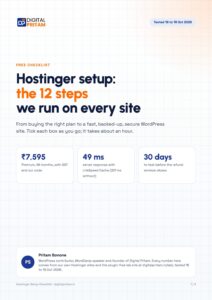
Get the Hostinger setup checklist, plus every sale alert
The exact steps we use on our lab sites, and an email when each big hosting sale opens.
Sent instantly. Deal alerts until 1 Dec. Unsubscribe in one click.


 Pritam Sonone