







Disclosure: some links on this page are affiliate links. If you buy through them we may earn a commission, at no extra cost to you.
Blogging means writing posts on a website and publishing them one after another, with the newest first. People find them through Google, social media or email. A blog can be a hobby, a business tool or a full-time job.
I build and publish on WordPress myself, and this site runs on Hostinger. This page explains what blogging is. When you are ready to build one, our step-by-step guide has real screenshots.
On this page12 sections
What is blogging?
Blogging is the habit of writing about a topic and publishing it online, again and again. Each piece is called a post. All your posts live on one site, called a blog.
The word comes from web log. At first, blogs were online diaries. Today a blog can teach a skill, review a product, share a story or explain the news. A good blog helps readers with one thing, and the writer keeps coming back, so readers do too.
What is a blog?
A blog is a website that shows your newest posts first. Each post has a title, a date, the text and often pictures. Readers can leave comments, share the post or join your email list.
Most blogs also have a few fixed pages. An About page says who you are. A Contact page lets people reach you. A Privacy page explains how you handle their data.
How does a blog work?
Think of a blog as a notebook that is open to the world.
- You write a post. You type it in an editor, like a document.
- You publish it. It gets its own web address.
- People find it. They search on Google, see it on social media, or get it by email.
- They read and react. They share it, comment or join your list.
- You keep going. More posts bring more readers over time.
Behind the scenes your blog needs two things: a domain, which is its address like yourname.in, and hosting, which is the computer that stores it. Free blogging platforms give you both. With your own hosting, you buy them yourself.
Blog vs website
| Blog | Plain website | |
|---|---|---|
| Content | New posts added over time | Fixed pages, changed rarely |
| Order | Newest first | A menu you choose |
| Goal | Keep readers coming back | Show a business or service |
| Example | A recipe diary or a news site | A clinic or company page |
| Comments | Often switched on | Usually off |
Many businesses use both: a normal website for services and a blog for helpful posts. The blog brings people in, and the website helps them decide.
Blogging vs vlogging vs social media
| Blogging | Vlogging | Social media posts | |
|---|---|---|---|
| Format | Written posts with pictures | Video, usually on YouTube | Short posts, photos, reels |
| Who owns it | You, on your own domain | The video platform hosts it | The platform owns the account |
| Found through | Google, links, email | YouTube search and suggestions | The platform’s feed |
| Lasts for | Years, if the post stays useful | Years, if the video stays useful | Often days |
| Good for | Step-by-step help and long answers | Showing how something looks or works | Quick updates and chats |
They work well together. Many creators write a post, make a video about it, and share both on social media.
Types of blogs
- Personal blogs. Your life, travel or thoughts.
- Niche blogs. One topic, like cooking, cricket or WordPress.
- Business blogs. A company shares tips to help customers.
- Review blogs. Products, tools or services explained and compared.
- News and magazine blogs. Fresh stories on a wider theme.
A niche blog is the easiest place to start. A narrow topic is easier to rank than a wide one, and your skill shows. To see how real blogs look and what each does well, read our list of 17 blog examples.
How do blogs make money?
Blogs earn in a few ways. None is guaranteed, and income usually takes months of steady work before it starts.
| Way | How it works | Good to know |
|---|---|---|
| Ads | A network shows ads on your pages | Check each network’s rules first |
| Affiliate links | You link to a product and may earn a commission if a reader buys | Say clearly that links are affiliate links |
| Your own products | Courses, ebooks, templates or services | Your blog builds trust in you |
| Sponsored posts | A brand pays for a post | Label them so readers are not misled |
| Services | Writing, design or consulting clients come from the blog | A blog shows your skill |
We make no earnings claim. Many blogs earn little or nothing, and the ones that do usually started with useful posts, not with ads.
Why people blog
- To share what they know. One post can help many people.
- To build a name. Clients and employers can see how you think.
- To grow a business. Posts answer questions and win trust.
- To earn on the side. Possible, but slow.
- To learn. Explaining things in public makes you learn faster.
Pick one main reason. It decides what you write and how you measure success. A blog on your own domain is also yours, while a social account can be limited or closed.
Which platform should you use?
There are two main kinds of blogging platform. Some are free and run on the platform’s own site. Others are software you install on your own hosting. WordPress.org is the second kind. Its About page says it is open source and licensed under the GPLv2, and that people with limited tech experience can use it out of the box.
What you get
- You own the blog and its content
- Thousands of themes and plugins
- You can add a shop or courses later
What to watch
- You pay for hosting and a domain
- You look after updates
What you get
- Free to start
- No hosting to manage
What to watch
- The company owns the place your blog lives
- It can change rules or show its own ads
We have not tested free platforms such as Blogger or Substack for this page, so we do not rate them. Our comparison of WordPress.com and WordPress.org explains the difference for the two WordPress versions.
How to start a blog: the short version
Starting is simpler than it sounds. In short:
- Pick a topic you can write about for a year.
- Choose a domain, your web address.
- Buy hosting. Hostinger’s Premium plan was ₹139 a month before GST on a 48-month plan on 15 Nov 2026.
- Install WordPress, choose a theme and publish your first post.
- Add About, Contact and Privacy pages, and keep your login safe.
Each of these steps has real screenshots, tips and warnings in our full guide: How to start a blog in 2026, 12 steps with real screenshots. That is the next step.
Follow the guide, then check the hosting price on the day you buy.
How we chose
Frequently asked questions
What is blogging in simple words?
Blogging means writing posts about a topic and publishing them on a website, again and again. The newest post shows first. People find the posts through Google, social media or email.
What is the difference between a blog and a website?
Every blog is a website, but not every website is a blog. A blog adds new posts over time and shows the newest first. A plain website has fixed pages that change rarely.
What is the difference between blogging and vlogging?
A blog is mainly written posts with pictures. A vlog is a video blog, usually on YouTube. Many creators do both and use the blog to explain what the video shows.
Is blogging still worth it in 2026?
It can be, if you pick a topic you know, write useful posts and stay steady. Search and AI answers are changing how people find content, so original, helpful writing matters more than word count. We make no promise about readers or earnings.
Can I earn money from blogging?
Many bloggers earn from ads, affiliate links, their own products or services. Nobody can promise a figure, and it usually takes months of steady work before there is any income.
Do I need to know coding to blog?
No. WordPress has a block editor where you write in boxes, a bit like a document.
How much does it cost to start a blog in India?
On 15 Nov 2026 Hostinger’s Premium plan was ₹6,672 for 48 months before GST, which is ₹7,873 with 18% GST. The WordPress software is free. Our guide on how to start a blog shows every cost.
Which platform should a beginner use?
For a blog you want to keep and grow, WordPress.org on your own hosting is the usual choice. Free platforms are fine for trying an idea, but you do not own the place your blog lives.
How long does it take to see results?
There is no fixed time. A new blog usually starts with few readers. Posting steadily and improving the posts that people read helps.
What is a niche blog?
A niche blog covers one narrow topic, like home gardening in Pune. A narrow topic is easier to write well and easier to rank than a broad one.
About this page

- WordPress developer and designer, builds sites for clients
- WordCamp Asia Communication Co-Lead
- 14K+ subscribers on the DigitalPritam YouTube channel
How we checked
Updated 15 Nov 2026Sources
- Hostinger web hosting, India (hostinger.in/web-hosting), read 15 Nov 2026
- WordPress.org: About (wordpress.org/about), read 15 Nov 2026
Keep reading
 How to start a blog
 17 blog examples
 What is SEO?
 How to do keyword research
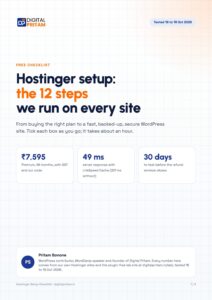 FREE PDF
Get the Hostinger setup checklist, plus every sale alert
The exact steps we use on our lab sites, and an email when each big hosting sale opens.
Sent instantly. Deal alerts until 1 Dec. Unsubscribe in one click.


 Pritam Sonone